Photo Project: Asamyutha Hastas by Srinivas

Bharatanatyam, one of the oldest classical dance forms of India, is not just a performance art but a medium that conveys stories, emotions, and philosophical concepts through precise movements. Central to this language of expression are the Asamyuta Hastas — the single-hand gestures — which form the foundational vocabulary of Bharatanatyam. Each Hasta carries a unique symbolism and emotion, allowing the dancer to narrate intricate stories with grace and clarity.
In collaboration with photographer Srinivas, I undertook a photo project to reimagine these Asamyuta Hastas, translating them into a visual narrative that captures both their traditional essence and a contemporary aesthetic. The project involved categorically presenting each Hasta, exploring its form, energy, and emotion, and transforming them into striking images that celebrate the art form while offering a fresh visual perspective.

Pataka (Flag)
Pataka is formed by keeping all fingers straight and together, with the thumb slightly bent. It is one of the most basic Hastas and is used to represent clouds, forest, wind, river, or to signal stopping.

Tripataka (Three-Leafed Flag)
Tripataka involves bending the ring finger while keeping the others straight. This Hasta signifies a crown, tree, arrow, lightning, or ornament, and is frequently used in storytelling.

Ardhapataka (Half-Flag)
Ardhapataka is made by folding the little finger while keeping the rest extended. It represents leaves, knife, riverbank, flag, or tower and is commonly used in both narrative and abstract sequences.

Kartari Mukha (Scissors Face)
Kartari Mukha is formed by extending the index and middle fingers while folding the others. It depicts separation, lightning, corner of eyes, or a blade, often conveying intensity or conflict.

Mayura (Peacock)
Mayura is shaped by touching the thumb and ring finger together, with other fingers extended. It represents a peacock, bird, or male figure, symbolizing beauty and elegance.

Ardhachandra (Half-Moon)
Ardhachandra is formed by extending the thumb away from the other fingers, which remain close. It denotes the moon, hand, or day, and is often used to depict celestial or abstract ideas.

Arala (Bent Arm)
Index finger bent towards the palm while other fingers extended. Depicts drinking, blowing, holding a stalk, or offering something delicately.
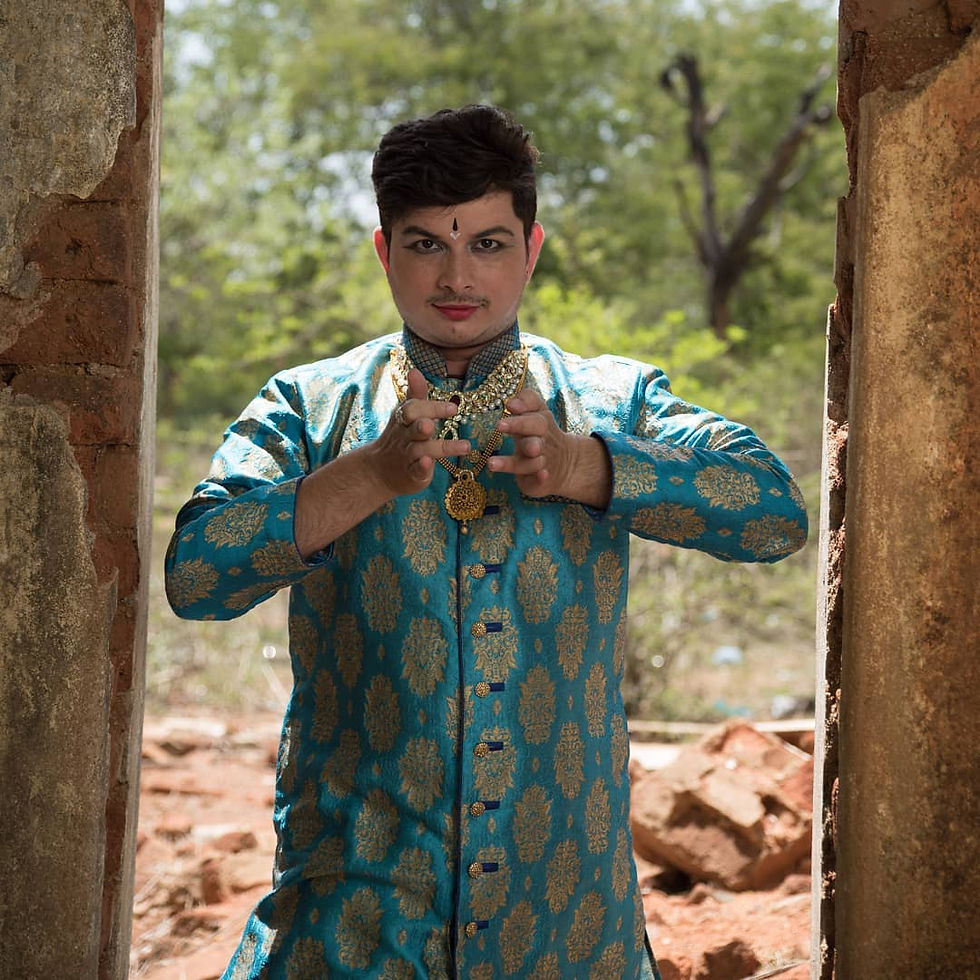
Shukatunda (Parrot’s Beak)
Index finger touches thumb, other fingers extended. Represents a parrot, creeper, or speech.

Mushti (Fist)
All fingers folded tightly into the palm. Symbolizes strength, firmness, or holding objects.

Shikhara (Tower)
Index finger extended upwards, others folded. Denotes pillar, bow, or person

Kapitta (Elephant’s Forehead)
Thumb touches the middle phalanx of the index finger, others extended. Represents holding objects, shooting arrows, or birds.

Katakamukha (Opening in a Bracelet)
Tips of thumb, index, and middle fingers joined; ring and little fingers extended. Depicts picking flowers, holding a necklace, or drawing a bow.

Suchi (Needle)
Index finger extended, others folded. Symbolizes pointing, showing, or an arrow.

Chandrakala (Half Moon / Crescent Hand)
Chandrakala is formed by keeping the thumb extended outward while the other fingers are straight and together. It represents the crescent moon, a hand, or the concept of day/night. This Hasta is used to depict celestial objects or abstract concepts in Bharatanatyam.

Alapadma (Lotus)
All fingers spread slightly, tips forming a soft outward curve like an open lotus. Represents holding flowers or offering, often used in devotional sequence

Padmakosha (Lotus Bud)
Padmakosha is formed by bringing the tips of all fingers together, forming a closed bud-like shape. It represents a lotus bud, holding flowers, offering, or containment, and is often used in devotional or expressive sequences.

Sarpashirsha (Snake’s Head)
Middle and ring fingers bent, others extended. Represents snake, creeper, or waves

Mrigashirsha (Deer’s Head)
Index and middle fingers bent, others extended. Symbolizes a deer, alertness, or curiosity.

Simhamukha (Lion Face)
Simhamukha is formed by folding the ring and little fingers while keeping the thumb, index, and middle fingers extended. It represents a lion, ferocity, courage, or roaring. It is often used to depict animals or expressions of strength and power.

Klangula / Kraagula (Claw / Hooked Hand)
Klangula (sometimes called Kraagula) is made by bending all the fingers at the first joint while keeping the thumb extended slightly. It symbolizes grasping, holding, or claw-like actions and is used to depict animals, trees, or powerful gestures in storytelling.

Hamsasya (Swan’s Beak)
Tips of thumb, index, and middle fingers joined, others extended. Represents writing, holding delicate objects, or a swan’s beak.

Bhramaram (Bee / Insect)
Bhramaram is formed by touching the tips of the thumb and middle finger, with the index finger slightly extended and the other fingers folded. It represents a bee, small flying insect, or delicate movement. It is often used in nature-related expressions.

Hamsapaksha (Swan’s Wing)
Ring and little fingers extended, others joined. Symbolizes a swan’s wing, flight, or openness.

Samdamsa (Joined Fingers)
All fingers tightly joined. Represents agreement, firmness, closure, or unity.

Mukula (Closed Bud)
Fingers curled gently with tips touching the thumb, forming a closed bud. Symbolizes potential, containment, or holding small objects delicately.

Tamrachuda (Copper Crest / Sword Edge)
Index and middle fingers slightly apart, thumb bent across the ring finger, others extended. Used to depict weapon edges, cutting, or sharpness in expression.

Trisula (Trident)
Formed by extending the index, middle, and ring fingers while folding the little finger and thumb. Symbolizes the trident of Lord Shiva or three-pronged objects.
This project with Srinivas was a celebration of Asamyuta Hastas, not just as a technical component of Bharatanatyam, but as living, breathing symbols of human expression. Each image captured the essence of the Hasta, exploring both its traditional significance and the new narratives we could create visually. By reimagining these gestures, the project bridges the worlds of classical dance and contemporary photography, inviting viewers to appreciate the richness, subtlety, and storytelling power embedded in every movement of the hand.
The project stands as a testament to Bharatanatyam’s enduring beauty — where even a single hand gesture, captured thoughtfully, can communicate universes of meaning.


Comments