
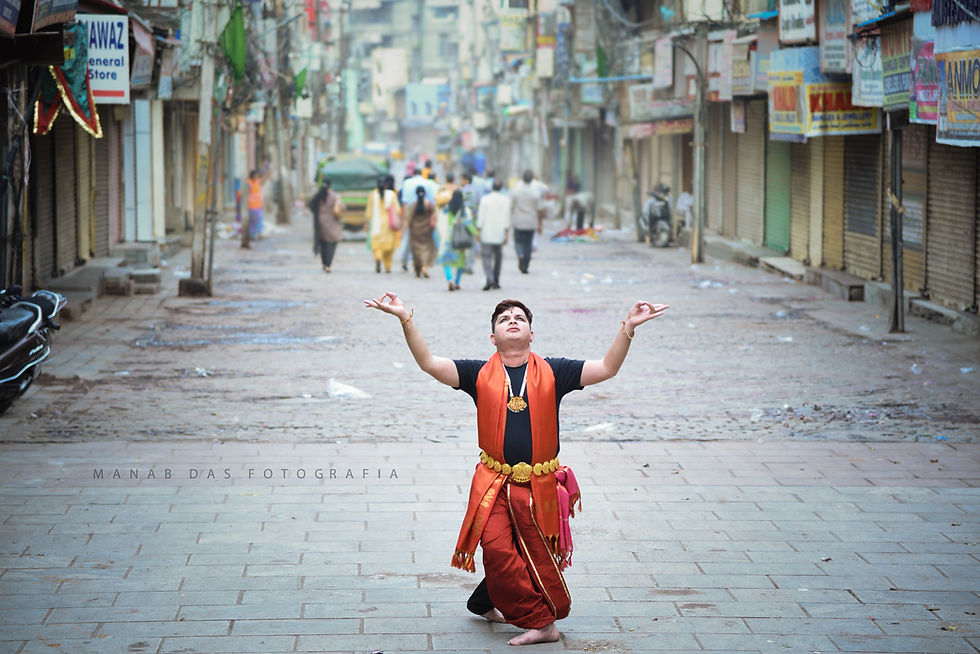
Dancer
In the bustling world of corporate meetings and PowerPoint presentations, there exists an anomaly named Patruni Chidananda Sastry.
Patruni Chidananda Sastry is an expressionist classical dancer whose practice bridges the rigor of Indian tradition with the radical possibilities of contemporary movement. Rooted in the classical forms of Bharatanatyam and Kuchipudi, his journey into dance began in early childhood, sparked by a deep fascination with the emotional power of performance. From a young age, he committed himself to disciplined training, eventually earning a Diploma in Bharatanatyam, which laid the technical and philosophical foundation for his evolving artistic voice.
Beginning his training at the age of seven, Sastry’s path was anything but easy. Choosing dance as a male performer in a society shaped by rigid gender expectations, he encountered skepticism, resistance, and at times ridicule. Yet these challenges became central to his artistic identity. Rather than retreat, he leaned into his practice, transforming dance into a medium of resilience, self-expression, and resistance.
As he progressed through his academic life, his engagement with dance began to shift from tradition to inquiry. Experiences such as ragging during his college years became pivotal moments, pushing him to use movement as a response to real-world issues like bullying and substance abuse. These early choreographic explorations marked the beginning of his commitment to socially engaged performance—where dance was not just aesthetic, but deeply political.
A defining evolution in his journey came with his exploration of expressionism. Drawing from avant-garde traditions, Sastry began to merge the codified language of classical dance with raw, emotive, and often unconventional forms of movement. This shift was further enriched by his diverse training: he holds a certificate in Butoh, the Japanese avant-garde dance form known for its intense physicality and emotional depth; he trained in contemporary dance at Attakkalari Centre for Movement Arts, one of India’s leading institutions for movement arts; and expanded his global vocabulary through vogue training in the United States, engaging with ballroom culture and its politics of identity and performance.
Through this rich and varied training, Sastry developed a movement language that is both grounded and experimental. His choreography resists boundaries—melding the precision of Bharatanatyam with the fluidity of contemporary, the introspection of Butoh, and the performative assertion of vogue. The result is a style that is deeply personal yet universally resonant.
His debut performance, “Closet,” marked a significant moment in his artistic career, exploring themes of gender fluidity and identity through a powerful blend of classical and expressionist movement. Since then, his works have continued to engage with complex and often taboo subjects, including sex education, societal prejudice, and the lived realities of marginalized communities. Each production is layered with symbolism and intention, inviting audiences to not just witness, but reflect and respond.
Central to Sastry’s work is a belief in dance as a tool for advocacy. His performances often amplify voices that are overlooked—particularly those within the LGBTQIA+ community, as well as sex workers and transgender individuals. Through his choreography, he challenges dominant narratives, creating space for dialogue, empathy, and transformation.
What distinguishes Sastry as a dancer is his refusal to separate art from activism. His stage becomes a site of confrontation and healing, where movement carries both aesthetic beauty and political urgency. Whether performing in intimate settings or larger platforms, he brings an intensity that is both visceral and thought-provoking.
Looking forward, Sastry continues to expand the scope of his practice, envisioning a world where expressionist dance moves beyond performance spaces and into everyday discourse. With a foundation rooted in tradition and a vision driven by change, Patruni Chidananda Sastry remains a powerful voice in contemporary dance—one that challenges, inspires, and redefines the possibilities of movement as a language of resistance and transformation.
Project Gallery


